From Spec Doc or BPMN to Governed Architecture
Upload a spec doc or a BPMN process. K9X Studio reads it and lays out a governed K9-AIF architecture on the canvas — Router, Orchestrators, Squads, and Agents, wired together with governance built in from the start.
or BPMN
Auto-Generates
Scaffold

pip install k9x && k9x studio
Start With the Right Architecture. Build Your Logic In.
k9aif inspect ensures it never drifts.
Generate Scaffold doesn't hand you a black box — it hands you a real Python project, structured exactly like the architecture you designed. Every Router, Orchestrator, Squad, and Agent is a Solution Building Block (SBB), wired to its K9-AIF Architecture Building Block (ABB) contract. You write the business logic. k9aif inspect checks that what you built still matches what you designed — every time you run it, not just on day one.
k9aif inspect
Validates every SBB against its ABB contract. Drift is caught, not shipped.
A Real Project Structure — Not a Black Box
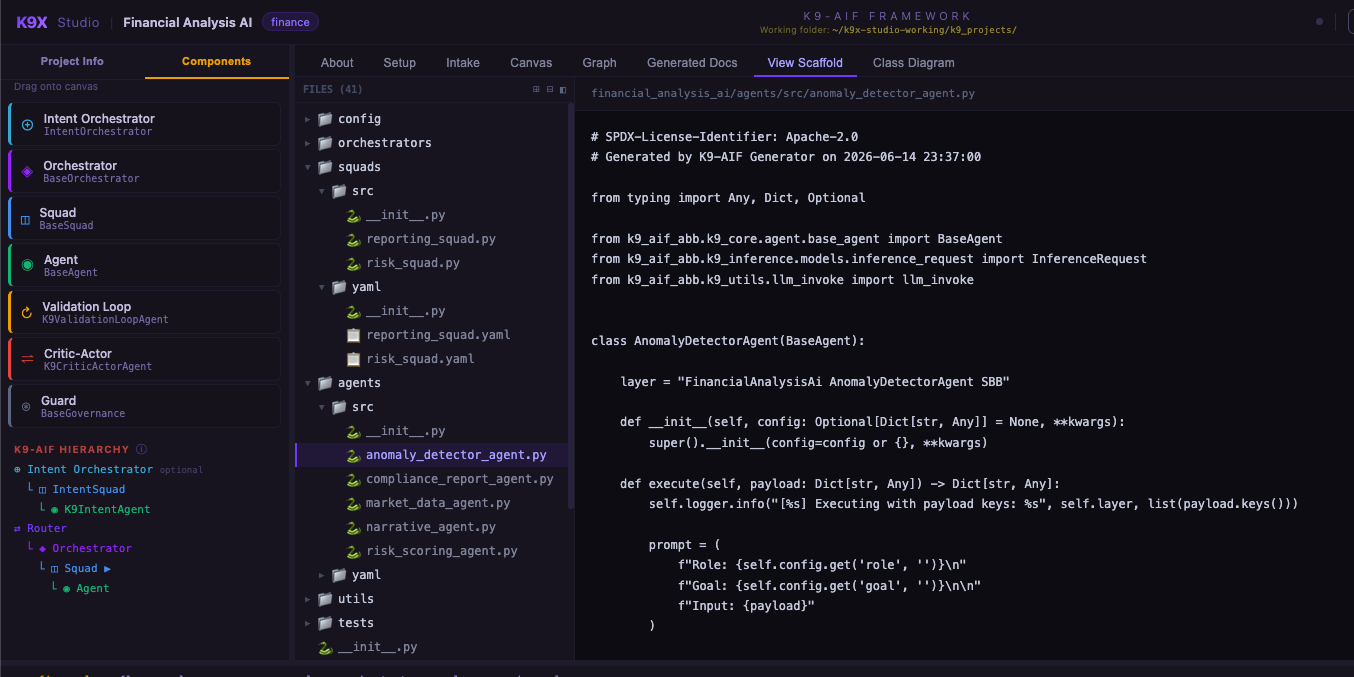
Generate Scaffold hands you an actual Python project: one folder per Router, Orchestrator, Squad, and Agent, each a Solution Building Block already wired to its K9-AIF Architecture Building Block contract.
Open it in your editor and the architecture you designed on the canvas is right there — in the folder tree, the class names, the imports. You write the business logic; the structure is already correct.
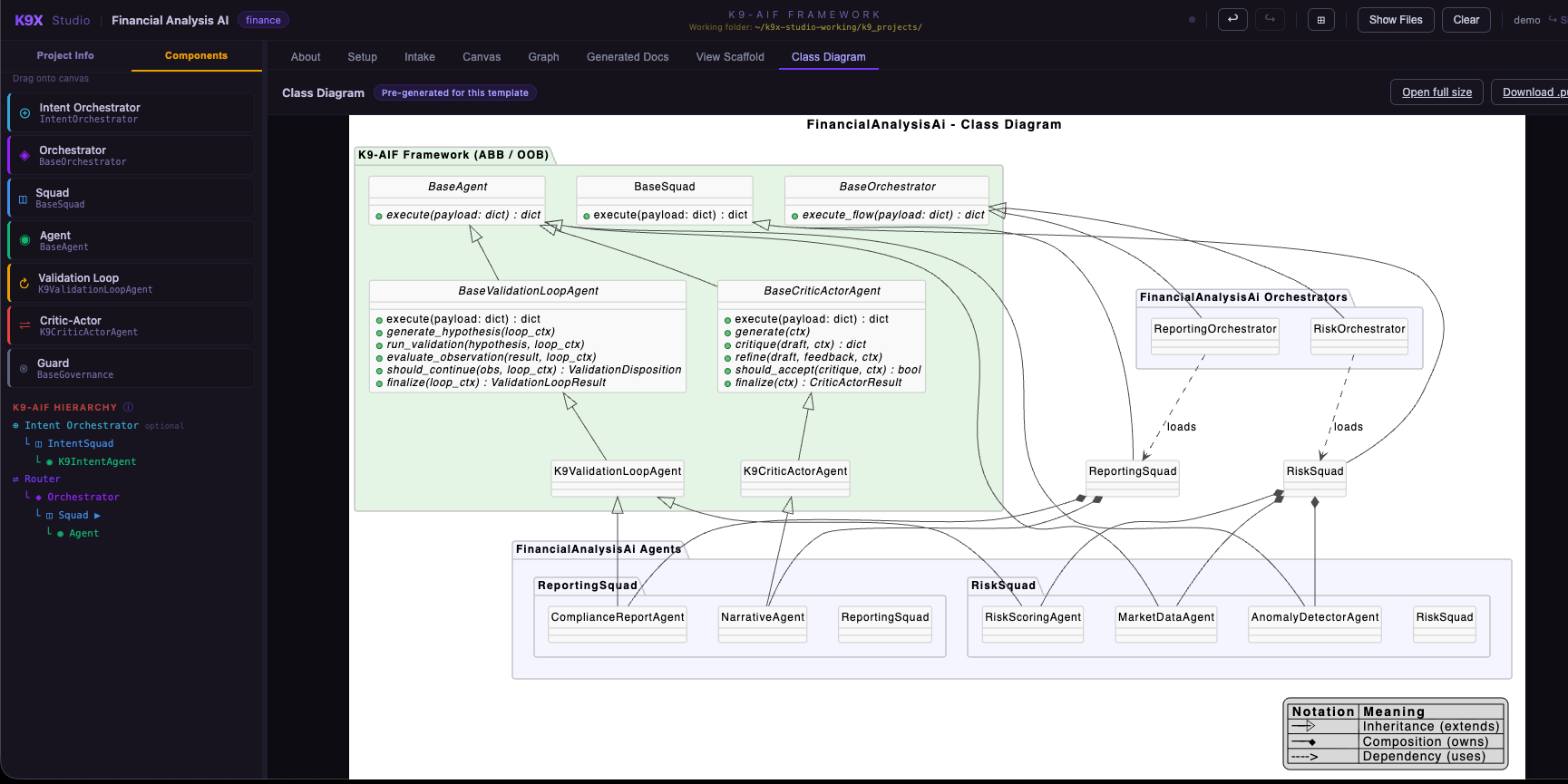
The Class Diagram Is the Compliance Report
"The entire history of software engineering is one of rising levels of abstraction. This is as it was, is now, and always shall be." — Grady Booch
K9-AIF's ABB classes are that next layer of abstraction for agentic systems. Every generated SBB extends an ABB base class — the inheritance itself is the contract. Look at the class diagram and you're looking at the compliance report: governance, validation loops, and message-bus wiring are inherited, not hand-rolled per agent.
That base layer also carries proven design patterns — critic-actor loops, validation loops, planning loops, and more. patterns.k9x.ai catalogs them, and why each one earns its place in the framework.
Architecture That Learns From Itself
Every SBB your team builds is a source of architectural knowledge. Proven patterns don't stay buried in individual implementations—they feed back into ABBs, strengthening the framework for every team that follows. Governance controls what gets promoted into the architecture. Reusable SBBs are cataloged and discoverable across the enterprise, providing visibility into pattern adoption, architectural reuse, and the lineage from ABBs to customized SBB implementations.
The Enterprise Continuum is a classification framework for organizing, cataloging, and reusing architectural assets — bridging high-level conceptual vision and tangible, implemented solutions, so architecture teams stop reinventing the wheel. K9-AIF is grounded in this TOGAF model:
k9_aif_abb/
Agent & governance contracts.
runtime
The framework running every agent.
k9_agents/
Validation-loop & critic-actor patterns.
shared agents
Running live across every squad.
examples/
The EOC reference implementation.
EOC deployment
Claims & fraud, live in production.
k9_projects/<App>
Generated scaffolds for one org.
customer deployment
One org's live, deployed instance.
Get Running in Minutes
No LLM needed to start. Full pipeline runs with mock provider — or launch the visual Studio with one command.
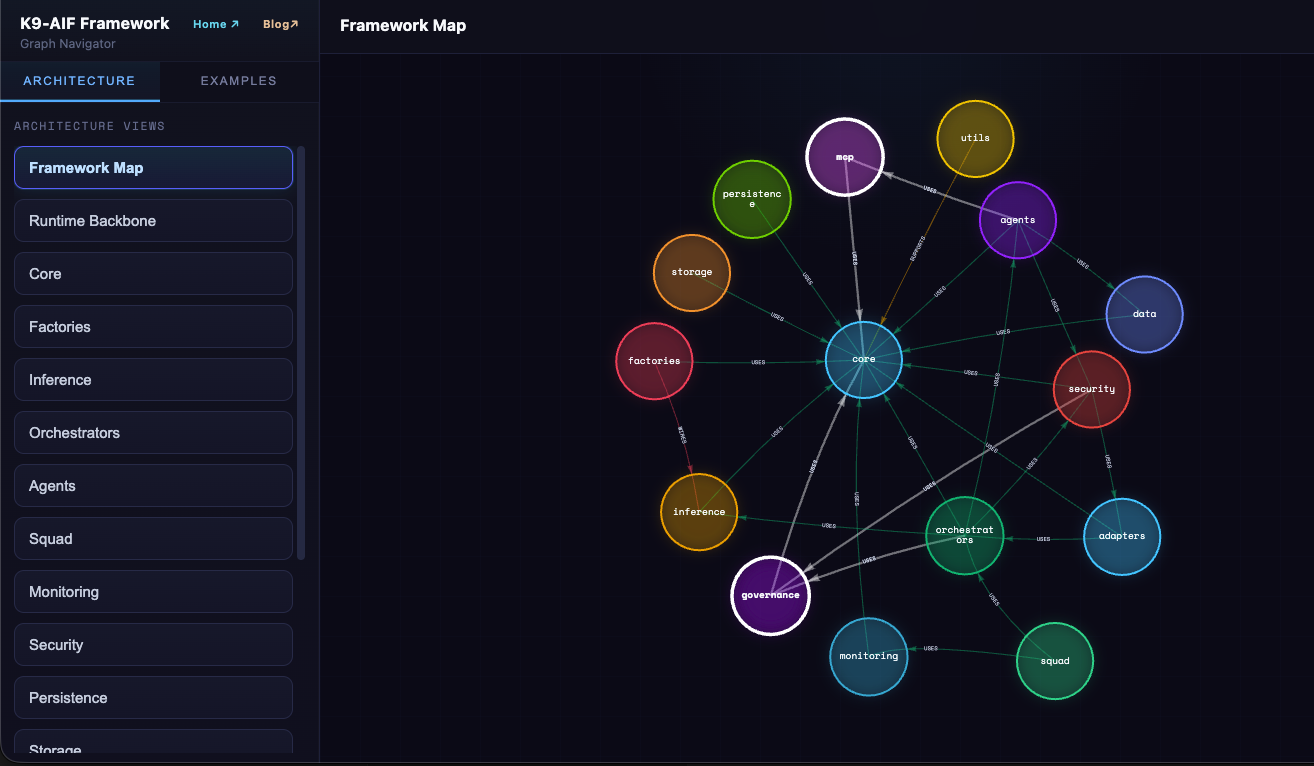
Architecture Hierarchy
A deliberate, layered execution model — every component has a defined role.
Each layer knows only the layer to its right. Never two steps ahead. Never back.
Built Like a Motherboard, Not a Traditional Framework
Applying architecture principles, patterns, and governance to the design and execution of agentic process flows and integrations.
Every framework, integration, and agent plugs into the same governed bus — routed, observed, and secured the same way, no matter what's connected.
Framework Principles
Architecture First
Design the system before writing code. ABBs define contracts. SBBs implement them.
Governed Execution
Every agent boundary enforces governance. Policy-checked before action executes. Enterprise operators lock ABB config keys that no SBB solution can override.
ABB / SBB Separation
Stable abstract contracts. Swappable concrete implementations. Eclipse-style extension points.
Zero Trust Execution
Every agent action verified and risk-evaluated prior to execution at the architecture layer.
Pluggable Providers
Ollama, Watsonx, OpenAI — swap via config. No code changes required.
Observable by Default
Every routing decision persisted. Full audit trail without extra instrumentation.
Enterprise Integration
Kafka, PostgreSQL, Neo4j, MCP. Production infrastructure, not demo infrastructure.
Vendor Neutral
No lock-in. LLM provider, messaging, persistence — all configurable, all replaceable.
The 2 A.M. Problem
It's 2 a.m., and an autonomous agent just approved a $40,000 reimbursement that should have been flagged for review.
Nobody wrote bad code. The agent did exactly what its prompt told it to do. The orchestration framework executed every step, on schedule. The demo worked great in front of the VP three weeks ago.
But there was no architecture between "agent decided" and "agent acted." No governed boundary checking the decision against policy before it executed. No audit trail explaining why. No contract defining what this agent was — and wasn't — allowed to do. Just a system prompt, a framework, and trust.
K9-AIF doesn't make your agents smarter. It makes the system around them accountable.
Because when that whistle blows at 2 a.m. — you'll hear it 100 miles away.
CLI Experience
K9-AIF ships with a full command-line interface. Verify, inspect, generate, and run — from the terminal.
Where K9-AIF Fits
K9-AIF defines how the full agentic AI system is architected.
- Frameworks like CrewAI define how agents collaborate
- Cloud platforms like Azure and AWS provide infrastructure
- Runtimes execute workflows
"I Already Use CrewAI. Why K9-AIF?"
Because they're not solving the same problem.
CrewAI — and LangChain — answer how agents collaborate: task delegation, tool calls, message passing. They're execution frameworks, and good ones.
K9-AIF answers a different question: what is this system, architecturally, and how do we know it's still that system tomorrow? Routers, Orchestrators, Squads, and Agents are ABBs with defined contracts. Governance, Zero Trust checks, and audit trails are wired in at the architecture layer — not bolted onto whichever framework happens to execute the work underneath.
K9-AIF doesn't replace your execution framework. It governs it.
About K9-AIF
K9-AIF did not begin as a grand architectural vision. It began as a retrieval capability — and evolved into an architecture-first framework for governed agentic AI systems.
Your agents deserve an architecture.
K9-AIF gives them one.
pip install k9-aif
Products
One architecture, from framework to runtime.